Where to get funding for your e-commerce business in the USA (SBA loans, Kiva, cards and more)
A plain-English map of every real place a US online store or physical-product brand can get money in 2026, from SBA loans and Kiva's 0% loans to Shopify Capital, inventory financing, grants and business credit cards, with the exact website for each.
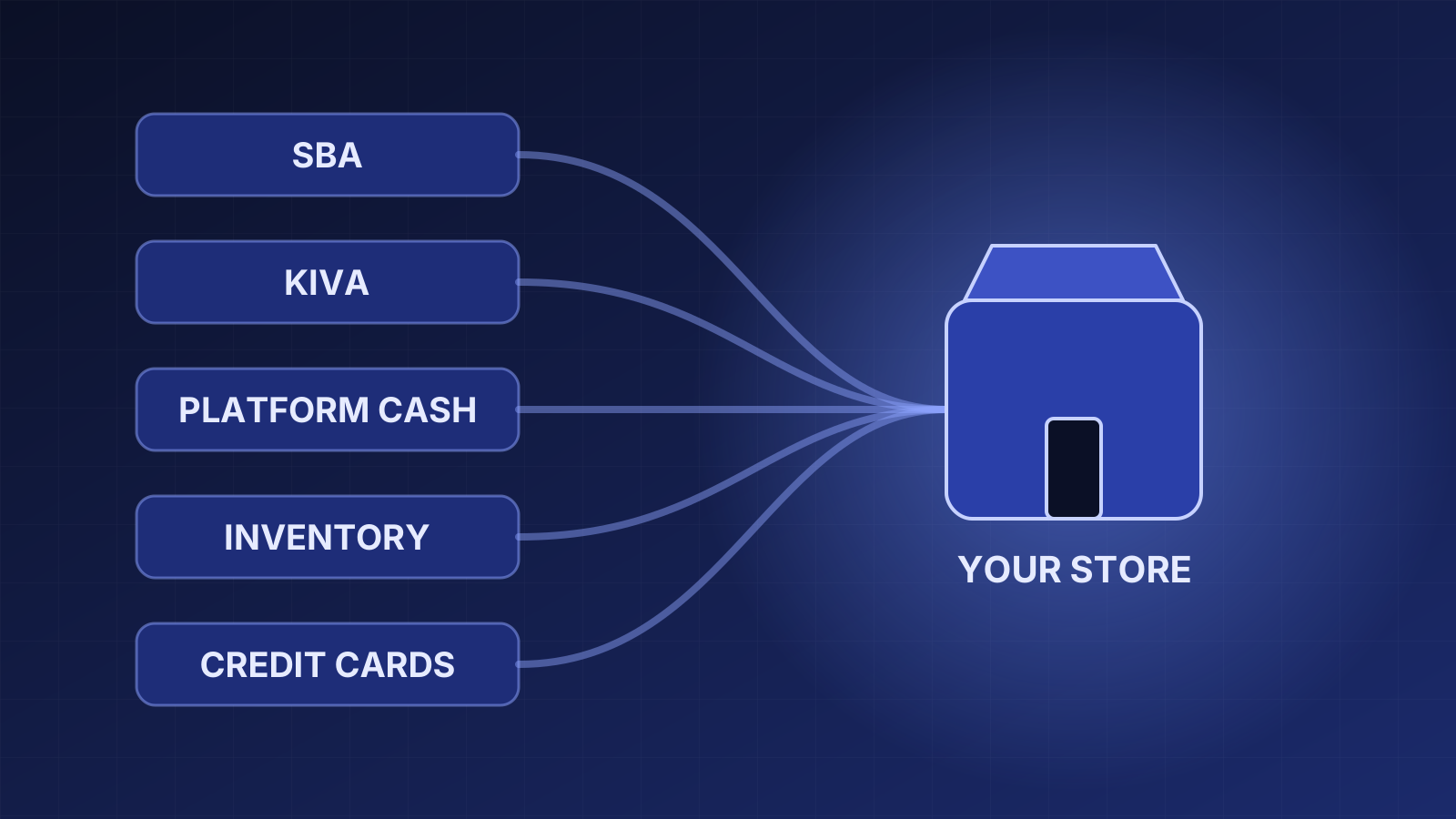
If you sell physical products, money problems show up in a very specific way. You have to pay for inventory weeks or months before a customer pays you, you have to pay for ads before those ads make a sale, and a good month can actually leave you with less cash because you had to reorder.
So "where do I get funding?" usually means one of three things:
- Inventory money: cash to buy stock before you sell it.
- Growth money: cash to spend on ads, a new product line, equipment or a warehouse.
- A cushion: a line of credit you hope you never use.
Each one has a better and a worse source. This guide walks through every real option for a US business owner, roughly in order from cheapest to most expensive, with the website you go to for each.
Quick note: this is general education, not personal financial advice. Rates and terms below were checked in November 2026 and change often. Always read the lender's current terms before you sign.
Start here: what lenders will ask you for
Almost every lender below asks for some version of the same packet. Get it ready once and every application goes faster:
- Business bank account separate from your personal one (lenders read it)
- Last 6–12 months of bank statements
- Sales history from Shopify, Amazon, Etsy, WooCommerce, Stripe or PayPal
- Last 1–2 years of tax returns (business and personal)
- A simple profit and loss statement, even one built in a spreadsheet
- Your personal credit score (most small-business loans still look at it)
- An EIN from the IRS and your formation documents (LLC or corporation)
- A one-page plan for the money: "$40,000 buys 2,000 units at $20 landed cost, which sell at $55 over 4 months"
That last line matters more than people think. A lender is far more comfortable funding inventory with a clear sell-through math than "growth".
1. SBA loans: the cheapest serious money
The US Small Business Administration doesn't usually lend to you directly. It guarantees part of a loan made by a bank, credit union or other approved lender, which lets that lender give you longer terms and lower rates than you would get otherwise. SBA also caps how far above the prime rate the lender can charge.
Where to go:
- Overview of every SBA loan program: sba.gov/funding-programs/loans
- Lender Match, SBA's free tool that sends your request to lenders who want to talk to you: sba.gov/lendermatch
The programs that matter for an online store or product brand:
| Program | Up to | Good for | Website |
|---|---|---|---|
| SBA 7(a) | $5 million | Inventory, working capital, buying a business, refinancing expensive debt | sba.gov 7(a) loans |
| SBA Express (a faster 7(a)) | $500,000 | Smaller working-capital needs, faster decision | sba.gov 7(a) loans |
| SBA 504 | $5–5.5 million | A warehouse, real estate, big equipment (printers, packaging lines, CNC) | sba.gov 504 loans |
| SBA Microloan | $50,000 | Newer brands, first inventory orders, equipment | sba.gov microloans |
In 2026 SBA also raised how much one business can hold across 7(a) and 504 loans combined to $10 million, which mostly matters for larger brands buying a building.
What to expect: SBA loans are the slowest option here. A 7(a) commonly takes 30–90 days and asks for a personal guarantee. Many lenders want at least 2 years in business, though microloan lenders and some community lenders work with newer businesses.
Best for: stores with a sales history that need a large amount at a low rate and can wait a few weeks.
2. Kiva: 0% interest loans up to $15,000
Kiva is a nonprofit that crowdfunds loans for US small businesses. The terms are hard to beat:
- $1,000 to $15,000
- 0% interest, no fees
- No collateral and no minimum credit score
- Repayment over 12 to 36 months
The catch is time and effort. Your loan is crowdfunded: first you invite friends, family and customers to lend during a private period, then it goes public on Kiva for anyone to fund. The whole thing can take several weeks.
That private period is actually a hidden benefit for a product brand. Your early lenders become your first fans, and a Kiva page is a reason to email your list and post on social.
Best for: a newer store that needs a first inventory order, a small equipment purchase or a website rebuild, and has some audience to rally.
3. Free help that leads to funding: SBDCs, SCORE and CDFIs
These aren't lenders, or not big ones, but they are where many owners find the right lender.
- Small Business Development Centers (SBDCs): free one-on-one advisors in every state, often at a local college. They will review your loan packet before you send it. Find yours at americassbdc.org.
- SCORE: free mentoring from retired business owners and executives at score.org.
- SBA's local assistance finder, which lists SBDCs, SCORE chapters, Women's Business Centers and Veterans Business Outreach Centers near you: sba.gov/local-assistance/find.
- CDFIs (Community Development Financial Institutions): mission-driven lenders that serve owners banks often turn down, including newer businesses, lower credit scores and underserved communities. Search the CDFI Locator from Opportunity Finance Network.
If a bank has already said no, a CDFI is usually the next call, not an expensive online lender.
4. Platform cash advances: Shopify, Amazon, PayPal, Stripe
If you already sell on a platform, it can see your sales and may offer you money without a traditional application. Repayment is usually taken as a share of each day's sales, so you pay back faster in a good month and slower in a slow one.
| Program | Who gets it | Website |
|---|---|---|
| Shopify Capital | Eligible Shopify merchants, by offer in your admin | shopify.com/capital |
| Amazon Lending | Amazon sellers, invite-only, through Amazon's lending partners | sell.amazon.com Amazon Lending |
| PayPal Working Capital | Businesses with enough PayPal sales history | PayPal Working Capital |
| Stripe Capital | Businesses processing through Stripe | stripe.com/capital |
The upside: fast, often money in a few days, no personal pitch, and payments flex with sales.
The downside: they are expensive once you convert the flat fee to an annual rate. A flat 10% fee paid back over 6 months works out to far more than a 10% yearly interest rate. Independent estimates put the effective cost of these products somewhere between about 15% and 50%+ a year depending on how fast you repay.
Best for: a short, clear inventory bet you know will sell through quickly, like restocking a proven bestseller before Q4.
5. Inventory and revenue-based financing built for e-commerce
A group of lenders exists only to fund physical-product brands. They look at your store data, not just your credit score.
- Kickfurther: a crowd of backers funds a specific inventory order, and you pay them back as that inventory sells.
- Wayflyer: revenue-based financing for e-commerce brands, often used for inventory and ad spend.
- Settle: lets you pay suppliers now and pay Settle later, stretching the gap between paying for stock and getting paid by customers.
Compare the true total cost of each against an SBA loan or a line of credit from your bank. They are usually faster and easier, and usually cost more.
6. Grants: free money, but slow and competitive
Grants don't need to be repaid, which is why everyone wants one and why most applicants don't win. Treat grants as a bonus, not a plan.
- Grants.gov: every federal grant. Most are for nonprofits and governments, not stores.
- SBIR.gov: federal research grants if your product involves real technology or R&D (a new material, a medical device, hardware).
- Amber Grant: monthly grants for women-owned businesses (there's a small application fee).
- Hello Alice: a running list of corporate-sponsored small business grants you can apply to.
- Your state and city economic development office: often the best odds, because fewer people apply. Search "[your state] small business grant".
Never pay someone who promises a guaranteed grant. Real grant programs don't work that way.
7. Crowdfunding: pre-sell the product before you make it
For a physical product, crowdfunding can be better than a loan: customers pay you before you place the factory order, and you learn whether people actually want it.
- Reward crowdfunding (customers pre-order): Kickstarter and Indiegogo.
- Equity crowdfunding (customers become small investors): Wefunder and Republic.
Campaigns that work almost always have an email list built before launch day. Plan a few months of list-building and some ad spend to drive pre-launch sign-ups.
8. Business credit cards: the fastest, and the easiest to misuse
A business credit card is often the first "funding" a store owner uses, because it is fast and every ad platform accepts it. Used well, it gives you:
- Up to about 55 days of float: you buy inventory or ads today and pay the bill after your statement closes.
- Cash back or points on spending you were doing anyway.
- 0% intro APR on some cards, which works like a short interest-free loan if you pay it off before the intro period ends.
- A business credit history, which helps you qualify for bigger loans later.
Used badly, it's the most expensive money on this list. Business card interest rates commonly run in the 18–30% range, so carrying a balance month to month wipes out any reward many times over.
Some solid options for product businesses in late 2026:
| Card | Rewards | Annual fee | Good for |
|---|---|---|---|
| Capital One Spark Cash Plus | Unlimited 2% cash back | $150 (refunded with $150k+ spend a year) | Big, steady spenders who pay in full each month |
| Amex Blue Business Cash | 2% on first $50k a year, then 1% | $0 | Smaller stores |
| Chase Ink Business Unlimited | 1.5% on everything | $0 | Simple, no fee, often has a 0% intro APR |
| Chase Ink Business Cash | 5% on office supplies and internet/phone (first $25k a year), 2% gas and dining | $0 | Software, shipping supplies from office stores |
| Chase Ink Business Preferred | 3x points on ads, shipping, travel, internet (first $150k a year) | $95 | Stores that spend heavily on ads and shipping |
| Amex Business Gold | 4x points on your top 2 categories each month (first $150k a year) | $375 | Heavy ad spenders who use points |
Which card to put your ad spend on is a whole topic of its own, so we wrote it up separately: the best credit cards for ad spend and how to stack them.
A simple rule: only put on a card what you can pay off in full when the bill comes, or what you're putting on a 0% intro APR card with a written plan to pay it off before the rate jumps.
Which funding fits which situation
| Your situation | Look at first | Then |
|---|---|---|
| Brand new, no sales yet | Kiva, SBA Microloan, crowdfunding pre-sales | A 0% intro APR card for small purchases |
| Selling 6+ months, need a first big inventory order | SBA Microloan or 7(a), a CDFI | Inventory financing like Kickfurther |
| Proven bestseller, need stock fast before a peak season | Shopify Capital, Amazon Lending, Wayflyer | A bank line of credit for next year |
| Profitable, 2+ years in, want to scale ads and products | SBA 7(a), a bank line of credit | Business card for the float and rewards |
| Need a warehouse or major equipment | SBA 504 | SBA 7(a) for the working capital around it |
| Turned down by a bank | A CDFI, Kiva, your local SBDC | Avoid stacking expensive merchant cash advances |
Mistakes that cost store owners the most
- Borrowing to fix a product or ad problem. If you lose money on every order now, more money makes you lose it faster. Check your numbers first; our guide to CAC, LTV and ROAS shows how.
- Comparing a flat fee to an interest rate. Always convert to a yearly cost before comparing two offers.
- Stacking several cash advances at once. Each one takes a share of daily sales, and together they can choke your cash flow.
- Mixing personal and business money. It makes every application harder and every tax season worse.
- Spending ad money before tracking works. If you can't see which ads make sales, borrowed ad money is a guess. Fix your tracking before you spend.
Make every borrowed dollar work harder
Funding buys you time. What you do with it decides whether you can pay it back. For most product brands, the biggest line item after inventory is ads, and that's where we can help: MarketingBuddy plans, launches and watches your ads, email and content for you, and tells you which campaigns are actually turning spend into sales, so borrowed money goes to what works.
Want your ad budget to go further? Start with MarketingBuddy and see where your spend is going in one place.
- Funding
- SBA loans
- Kiva
- Ecommerce
- Inventory
- Business credit cards
- Shopify
Let your AI run the marketing. You keep the final say.
Connect your ads, analytics, store and email, and approve every change before it goes out.